

Tennant Company 2013 - to - Present
Working as a Technician for the Tennant Company is rewarding in having the opportunity to work with an outstanding dedicated team on a variety of the latest technologies. One of newest machines is the Trumpf L58 fiber optic laser. Of all the lasers I’ve seen, this one cuts beautifully…, and fast. Another impressive process is our M-710i dual cell Fanuc robotic welders. It utilizes and touch-off function that “feels” the seam prior to welding. These two robots can burn through a serious amount of .045” wire quite quickly. I will say the process needs to be set-up strategically with regard to the touch-off function to achieve the best possible welds. We also have Yaskawa Motoman welding robots that can do a fine job but the their parts availbility was dis-continued in 2014. In the near future, there is the possibility of integrating Fanuc robots to automate the loading of our 6 axis Cincinnati press brakes. The press brakes are quite reliable but I am surprised Cincinnati, Inc. hasn’t developed their own automated loading system, the manual labor needed for operation has always seemed arcaic to me. I did get a chance to visit their factory and they are a solid company with integrity. To this day, they won’t sell a machine or parts to a communist country. Much of their focus is comsumed by their new line of lasers and 3D printers. Also they seem to be finding their way with the new CAN bus or Profibus architecture. As a process technician, be aware that the newer machines using this protocol are more robust but some of the replacement parts have to be flash programmed prior to swapping them out, which, means you need the software tools, or alternatively, schedule a service tech to complete the repair.American Classic Conversions, LLC 2010 - Present
It’s our goal here at American Classic Conversion to provide the customer with all the detailed information of their vehicle’s conversion. If you’ve ever had the inspiration to become less reliant on expensive and dirty petrol cars. Converting to 100% electric is the answer. Here at American Classic Conversions we’ve decided to combine the best of both worlds; Classic gas guzzler beauties and electric motor drive trains. The notion of using your classic car as a daily driver for just pennies a day could be a very real experience. This all became possible as little as four or five years ago with the advancement of lithium-ion phosphate battery modules. Prior to then, lead acid batteries simply couldn’t store enough energy to make the energy-to- weight ratio sufficient to give heavier vehicles any kind of practical driving range. With current lithium-ion battery chemistry (LiFePO4), vehicles weighing 2,500 to 3,500 lbs. can achieve ranges of 80 to 120 miles between charge cycles. Additional benefits to consider include the maintenance free operation of electric motors and the clean use of battery power, no gas, no oil and no exhaust fumes. The only oils left in the vehicle are transmission oil, brake fluid and air conditioner oil, all of which require maintenance at around 100,000 mile intervals so your car can run maintenance free for 8 to 10 years. Brakes are even low maintenance due to the regenerative slow-down effect of the AC motor. The payback on the conversion is in the neighborhood of 4 to 6 years depending on how you charge your batteries. At American Classic Conversion we’ve developed a heating system for the battery packs allowing winter time use in even the coldest regions. Maintaining a stable pack temperature will also prolong the life cycles of the batteries, which is typically 3,000 discharges or approximately 12 years. Our patented thermal plates utilize anti-freeze coolant circulating throughout the battery pack maintaining a controlled temperature, summer or winter. I’ve always had a great affinity for classic cars and their place on our highways. They seem to make a subtle statement when their spotted going down the road. Something of a nostalgic presence that quietly speaks to the great years of manufacturing. Included in that nostalgia are the engines, so we carefully clean, lubricate, seal and band them to a storage pallet for use many years later should the owner decide to retrofit them back to the vehicles original state. We also document every detail that’s been done with their car, from wiring harnesses to shock absorbers. Our intention is to be as least invasive to the vehicle as possible. On with the good stuff: We’re working on a ‘66 Corvair conversion that will have a 25.9 kW battery pack, 144vDC pack consisting of 39 battery modules producing 180AH each. The drive train will be the newest AC motor called the AC-75, which, is capable of 180 ft. lbs. of torque at 3000 RPM. The Corvairs’ original 4 speed rear mounted transaxle will be paired with the AC-75 motor by way of a 1.125” locking hub, a machined adapter plate will establish the bolt pattern and distance to the locking hub. The battery power will be configured using 3 battery boxes, 2 in the rear and a large box in the front giving the desired 60/40 weight distribution. Coolant/heater lines circulate in series through all 3 of the insulated battery boxes and are controlled by a independent ARM7 microprocessor to maintain the optimum 60 degrees (F) temperature. Currently in development are five ARM7 microprocessor boards with a built in CAN interface; The 32bit processors will communicate their commands and monitor status by way of the CAN interface allowing for around the clock monitoring of the vehicle systems. The status of the systems are displayed on a retractable 10.4” touch screen mounted under the dash console. Sensor inputs include hall effect switches, thermocouples, infrared sensors, accelerometers, ammeters, event counters, GPS module and photo electric sensors. The ARM7 CAN interface board has been developed to be programmed as a node on the CAN network giving us the flexibility to add additional nodes as requested by the customer. For instance if the customer would like to add interior or exterior lighting, this can be done by simply adding an additional board without modifying the original wire harness as CAN protocol only requires two twisted-pair wires. Or possibly including a wireless adapter for communications with a smart phone or home network. Concurrent development work is being done with Vehicle-To-Grid configurations, or V2G. Using your car to “put back” power to the grid would enable the customer to receive credits from the utility company. As testing progresses future development work will be done to charge the vehicle from a solar car port allowing zero cost and zero emission transportation. Our commitment is to work with the customer introducing them to the viability of electric vehicles, training them on the conversion and operation with an open source approach on future development of our countries infrastructure as it moves inevitably toward EV’s. One exciting project is taking place in Germany, a partnership with Bombardier converting two city buses for use on a dedicated route with inductive charge pads strategically located at bus stops so the bus will charge as the passengers board. Another promising development is being done by Tesla Motors in which Level 2 charge stations are being installed across the country so EV’s can stop for a 20 minute full charge allowing them to travel long ranges.



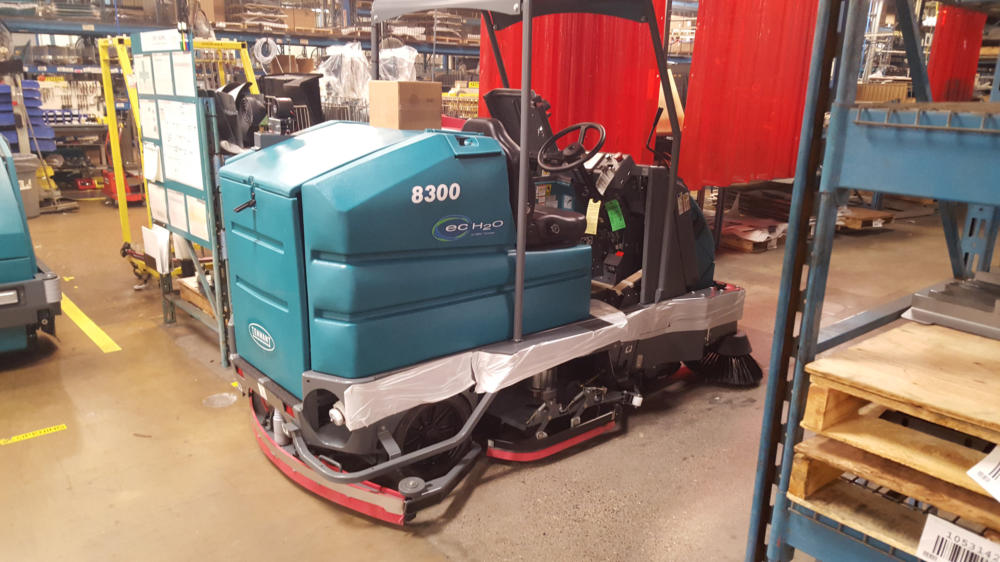
Our Fanuc Dual Welding Robots














Tennant Company 2013 - to - Present
Working as a Technician for the Tennant Company is rewarding in having the opportunity to work with an outstanding dedicated team on a variety of the latest technologies. One of newest machines is the Trumpf L58 fiber optic laser. Of all the lasers I’ve seen, this one cuts beautifully…, and fast. Another impressive process is our M-710i dual cell Fanuc robotic welders. It utilizes and touch-off function that “feels” the seam prior to welding. These two robots can burn through a serious amount of .045” wire quite quickly. I will say the process needs to be set-up strategically with regard to the touch-off function to achieve the best possible welds. We also have Yaskawa Motoman welding robots that can do a fine job but the their parts availbility was dis-continued in 2014. In the near future, there is the possibility of integrating Fanuc robots to automate the loading of our 6 axis Cincinnati press brakes. The press brakes are quite reliable but I am surprised Cincinnati, Inc. hasn’t developed their own automated loading system, the manual labor needed for operation has always seemed arcaic to me. I did get a chance to visit their factory and they are a solid company with integrity. To this day, they won’t sell a machine or parts to a communist country. Much of their focus is comsumed by their new line of lasers and 3D printers. Also they seem to be finding their way with the new CAN bus or Profibus architecture. As a process technician, be aware that the newer machines using this protocol are more robust but some of the replacement parts have to be flash programmed prior to swapping them out, which, means you need the software tools, or alternatively, schedule a service tech to complete the repair.American Classic Conversions, LLC 2010 -
Present
It’s our goal here at American Classic Conversion to provide the customer with all the detailed information of their vehicle’s conversion. If you’ve ever had the inspiration to become less reliant on expensive and dirty petrol cars. Converting to 100% electric is the answer. Here at American Classic Conversions we’ve decided to combine the best of both worlds; Classic gas guzzler beauties and electric motor drive trains. The notion of using your classic car as a daily driver for just pennies a day could be a very real experience. This all became possible as little as four or five years ago with the advancement of lithium-ion phosphate battery modules. Prior to then, lead acid batteries simply couldn’t store enough energy to make the energy-to-weight ratio sufficient to give heavier vehicles any kind of practical driving range. With current lithium-ion battery chemistry (LiFePO4), vehicles weighing 2,500 to 3,500 lbs. can achieve ranges of 80 to 120 miles between charge cycles. Additional benefits to consider include the maintenance free operation of electric motors and the clean use of battery power, no gas, no oil and no exhaust fumes. The only oils left in the vehicle are transmission oil, brake fluid and air conditioner oil, all of which require maintenance at around 100,000 mile intervals so your car can run maintenance free for 8 to 10 years. Brakes are even low maintenance due to the regenerative slow-down effect of the AC motor. The payback on the conversion is in the neighborhood of 4 to 6 years depending on how you charge your batteries. At American Classic Conversion we’ve developed a heating system for the battery packs allowing winter time use in even the coldest regions. Maintaining a stable pack temperature will also prolong the life cycles of the batteries, which is typically 3,000 discharges or approximately 12 years. Our patented thermal plates utilize anti-freeze coolant circulating throughout the battery pack maintaining a controlled temperature, summer or winter. I’ve always had a great affinity for classic cars and their place on our highways. They seem to make a subtle statement when their spotted going down the road. Something of a nostalgic presence that quietly speaks to the great years of manufacturing. Included in that nostalgia are the engines, so we carefully clean, lubricate, seal and band them to a storage pallet for use many years later should the owner decide to retrofit them back to the vehicles original state. We also document every detail that’s been done with their car, from wiring harnesses to shock absorbers. Our intention is to be as least invasive to the vehicle as possible. On with the good stuff: We’re working on a ‘66 Corvair conversion that will have a 25.9 kW battery pack, 144vDC pack consisting of 39 battery modules producing 180AH each. The drive train will be the newest AC motor called the AC-75, which, is capable of 180 ft. lbs. of torque at 3000 RPM. The Corvairs’ original 4 speed rear mounted transaxle will be paired with the AC-75 motor by way of a 1.125” locking hub, a machined adapter plate will establish the bolt pattern and distance to the locking hub. The battery power will be configured using 3 battery boxes, 2 in the rear and a large box in the front giving the desired 60/40 weight distribution. Coolant/heater lines circulate in series through all 3 of the insulated battery boxes and are controlled by a independent ARM7 microprocessor to maintain the optimum 60 degrees (F) temperature. Currently in development are five ARM7 microprocessor boards with a built in CAN interface; The 32bit processors will communicate their commands and monitor status by way of the CAN interface allowing for around the clock monitoring of the vehicle systems. The status of the systems are displayed on a retractable 10.4” touch screen mounted under the dash console. Sensor inputs include hall effect switches, thermocouples, infrared sensors, accelerometers, ammeters, event counters, GPS module and photo electric sensors. The ARM7 CAN interface board has been developed to be programmed as a node on the CAN network giving us the flexibility to add additional nodes as requested by the customer. For instance if the customer would like to add interior or exterior lighting, this can be done by simply adding an additional board without modifying the original wire harness as CAN protocol only requires two twisted-pair wires. Or possibly including a wireless adapter for communications with a smart phone or home network. Concurrent development work is being done with Vehicle-To-Grid configurations, or V2G. Using your car to “put back” power to the grid would enable the customer to receive credits from the utility company. As testing progresses future development work will be done to charge the vehicle from a solar car port allowing zero cost and zero emission transportation. Our commitment is to work with the customer introducing them to the viability of electric vehicles, training them on the conversion and operation with an open source approach on future development of our countries infrastructure as it moves inevitably toward EV’s. One exciting project is taking place in Germany, a partnership with Bombardier converting two city buses for use on a dedicated route with inductive charge pads strategically located at bus stops so the bus will charge as the passengers board. Another promising development is being done by Tesla Motors in which Level 2 charge stations are being installed across the country so EV’s can stop for a 20 minute full charge allowing them to travel long ranges.